

Maintenance departments are normally associated with high costs, long wait times and recurring operational issues. This image could be eradicated within a very short time by understanding the difference between “technical cause” and “root cause.” The emphasis is always on fixing the issue so that we can have production running again.
Let’s look at the diagram below. Any deviation from standard is something that a maintenance technician is trained to diagnose and fix in a very short space of time. The technician’s focus is about finding the technical cause and not so much about finding the root issue.
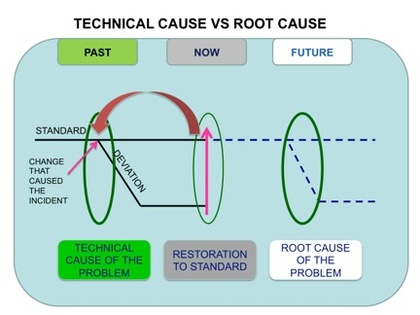
The maintenance professional needs to master three skills to be highly effective in solving problems:
- The ability to quickly identify the appropriate actions to restore production.
- The ability to find the technical cause of the problem: something happened and the technician needs to find the change that caused the problem.
- The ability to determine the root cause of the problem.
A technical cause is “an event in time” and a root cause is different in nature, because it is “a condition that exists”.
For example, let’s take paint on a car assembly line. The technician finds that the reason for the subpar paint jobs on the cars is actually the poor washing solution, due to too many units going through the same body of washing fluid. The change that took place is “Increased Volume” of cars, and that is something that happened, and therefore a technical cause.
However, now using the 5 WHY’s to determine the root of the same situation, the technician can arrive at a systemic problem situation. In the paint situation, it is possible that there is no procedure in place to follow for fluctuating volumes of production, which would be a root cause.
The question is “why not?” Asking this question helps to find a solution to monitor fluctuating volumes, and could lead to unlimited cost savings. Such as: 1. Eliminating the possibility of this problem recurring, 2. Arriving at a new innovative solution to deal with volume fluctuations automatically and 3. Implementing this same solution in other similar production situations.
This simple act of understanding that there are normally two answers to a problem i.e. technical and root cause answers could jumpstart an array of exciting fixes that could result in substantial savings!
This blog post was authored by Mat-thys Fourie, Partner of Thinking Dimensions Global